Skip to Content
Follow us
Click here to setup your social networks
Sign in
Contact Us
Home
Services
Transformation & Structuring
Implementation & Enablement
Capability & Adoption
Platforms
ARIS
ServiceNow
Alfabet
Insights & Community
AI-era vision
Courses
Events
Company
About us
Industries
Jobs
Support Request
Contact us
Home
Services
Transformation & Structuring
Implementation & Enablement
Capability & Adoption
Platforms
ARIS
ServiceNow
Alfabet
Insights & Community
AI-era vision
Courses
Events
Company
About us
Industries
Jobs
Support Request
Contact us
Follow us
Click here to setup your social networks
Sign in
Contact Us
Courses
Your Level
Advanced
Basic
Intermediate
Intermediate
Softskills
Technical Skill
Functional Skill
Certifications
All Courses
Aris User group November 2024
Aris User group February 2025
ARIS Super user group 2025
Presentations & Recordings of the ARIS Super user group
Intermediate
New Content
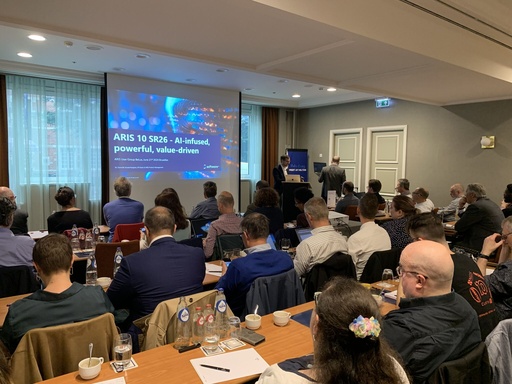
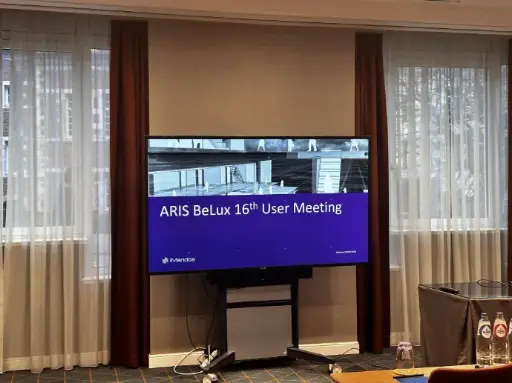
ARIS BeLux User group September 2026
ARIS Process Intelligence Strategy:
Julie explained that ARIS is shifting toward a unified process intelligence platform that connects process design, execution data, and enterprise AI through a living digital twin, with capabilities delivered in both cloud and on-premises environments.
Digital Twin:
Julie described the ARIS digital twin as a structured representation of how an organization is designed and how it operates. The designed view includes processes, standard procedures, policies, controls, regulations, roles, applications, and dependencies; the observed view is supplied by execution intelligence and process mining. Keeping both views connected is intended to provide reliable context for operational improvement and AI agents.
Enterprise AI Context:
Julie distinguished personal AI tools from enterprise AI agents. An agent should receive organizational context in the same way a new employee receives policies, procedures, roles, and operating guidance. Without this context, an agent may execute tasks without understanding the organization’s rules or dependencies.
ARIS Roadmap:
ARIS is consolidating ARIS Design and ARIS Mining capabilities into a process intelligence platform. Julie highlighted ARIS Flows for workflow execution and lifecycle governance, improved AI Companion responses grounded in ARIS content, web-based simulation, object-centric process mining, Process Lens for AI-readiness scoring, and Model Context Protocol connectivity.
Release Model:
Cloud or SaaS customers may receive monthly ARIS releases, while on-premises customers receive releases twice yearly, generally in April and October. Julie stated that the new process-intelligence capabilities are being made available for both deployment models.
AI Readiness And Process Improvement:
Julie emphasized that AI capability is growing faster than enterprise value and argued that organizations should redesign work, establish process context, and use execution evidence before scaling AI initiatives.
Value Gap:
Julie reported that organizations are running many AI pilots and isolated use cases, but often cannot explain their business benefit. The main challenge is therefore no longer whether AI works, but how to make it operate predictably and at scale across the enterprise.
Process Context:
Julie explained that general AI vendors do not inherently know an organization’s processes, controls, policies, exceptions, dependencies, or people. ARIS is positioned to supply this missing process context so that AI can operate against governed organizational knowledge rather than generic information.
Process Lens:
The planned Process Lens capability evaluates processes against user-defined indicators such as operational excellence, efficiency, AI enablement, goal-oriented work, and data privacy. It scores activities as positive, negative, or neutral against the selected objectives so organizations can prioritize where AI investment is appropriate.
Simulation And Mining:
Julie explained that process mining can provide actual path probabilities and execution behavior, while simulation can test proposed changes before implementation. Combining the designed model, observed execution, and simulation can reveal bottlenecks and help assess the consequences of deploying automation or AI agents.
Object-Centric Mining:
Object-centric process mining expands analysis beyond a single case by following related objects such as orders, order lines, invoices, packages, incidents, problems, or changes. Julie said this provides a broader operational view and can expose relationships that are lost when each end-to-end process is analyzed separately.
SNCB Enterprise Process Management Journey:
Ivan Kovacic and Carlos Massange described how SNCB moved from fragmented local process modelling to an enterprise-wide ARIS capability, using governance, BPMN standardization, quality controls, and cross-directorate collaboration.
Starting Challenges:
Before 2020, SNCB directorates used different modelling tools, methodologies, and documentation practices. The organization had limited process-management maturity, no single repository, unclear process ownership, and a silo-oriented way of working, making it difficult to find reliable information across departments.
Strategic Turning Point:
The team established a common process map, selected BPMN as the shared modelling language, and acquired ARIS as the intended single repository. The shERPa SAP S/4HANA program provided an important opportunity to align processes across operational and support directorates and to extend ARIS use across the company.
Governance Structure:
SNCB created a Process Forum of approximately 20 representatives meeting monthly to discuss progress, issues, standards, and ARIS developments. The Process ARIS Community includes approximately 50 process managers and supports training and good-practice exchange, while a seven-person Process Core Team addresses methodology questions, transversal processes, role modelling, and standards.
Quality Assurance:
SNCB uses separate work-in-progress, training, and publication databases. Automated semantic checks verify items such as multilingual content and modelling conventions; experienced process modellers conduct peer reviews for methodology conformity and readability; and business process owners validate agreed changes before publication.
Connected Management Domains:
SNCB is linking processes with audit, risks, applications, organization, HR, data privacy, regulations, indicators, strategy, and KPIs. Application information is connected from the CMDB, while organizational information comes from SAP. The team is also exploring how to move risk information from spreadsheets and SharePoint into an integrated ARIS-based view.
Current Scale And Next Steps:
SNCB has approximately 2,000 processes in ARIS. Its roadmap moves from process design to business intelligence, process intelligence, and process orchestration, including process mining, task-oriented mining, AI champions, and agents. The team stressed that stable processes, trusted data, and clear ownership must come before orchestration.
SNCB Lessons And Q&A:
SNCB presenters explained how bottom-up sponsorship, quality foundations, and integration with audit, risk, and KPI practices supported adoption, while acknowledging that scaling the process community and cleaning the repository remain ongoing work.
Executive Sponsorship:
In response to a question about sponsorship, Carlos said SNCB began with support from their own directorate rather than waiting for a lengthy enterprise decision. A small team acquired ARIS, demonstrated value, and used the shERPa program as leverage to expand adoption. Ivan added that a supportive directorate enabled the initial team to grow from two or three people to six and that bottom-up adoption required time to build durable organizational acceptance.
Process Mining Sequence:
In response to a question about whether process mining should precede process documentation, the presenters said mining is more valuable when the organization understands the activities and captures detailed execution data such as timestamps and quantities. SNCB is testing mining to reconstruct the causes of train delays across departure, preparation, routing, and staffing systems, which is currently a manual investigation.
Risk And Audit Integration:
SNCB stated that process-oriented risks are being linked to process levels in cooperation with service management and risk-related offices. Operational safety risks and business-continuity risks are treated as distinct areas, with the latter being progressively embedded into ARIS. For audit, process attributes and parameters are reviewed annually with process owners, while the longer-term goal is to automate more of the assessment.
KPI Documentation:
KPI definitions are currently maintained in Word files attached to processes, including their source and origin. SNCB intends to move this information directly into ARIS and maintain links between KPIs and the reports in which they are used.
Repository Cleanup:
The presenters said SNCB moved too quickly at the beginning and now needs to clean and improve a library of approximately 2,000 processes. Their guidance was to invest in first-time-right modelling and library structure, actively convince other directorates to participate, and avoid overloading the same environment with multiple major projects.
Enterprise Architecture And ITSM Integration:
Mark Straathof presented Viterra’s enterprise architecture journey, in which ARIS was used as the authoritative architecture repository and ServiceNow as the workflow platform, supported by ArchiMate, BPMN, governance, and project-start architectures.
Viterra Architecture Setup:
After Viterra was carved out of Glencore in 2020, the company needed new corporate IT, enterprise architecture, operations, and information-security capabilities. Mark established architecture principles and standards, a governance process, and a 13-person architecture team covering enterprise, data, solution, ERP, software development, integration, infrastructure, security, and business continuity.
Integrated Designs:
Viterra created integrated architecture designs covering business processes, applications, data, technology, infrastructure, controls, and security. ARIS stored the designs using ArchiMate and BPMN, and the project-start architecture established the approved baseline for an initiative before implementation.
Project Governance:
Project-start architectures were modelled in ARIS, reviewed by other architects through ARIS Connect, converted into timestamped PDF documents, and stored with approval decisions in Confluence. IT operations eventually required an approved design before starting a project, supporting more predictable delivery.
ARIS And ServiceNow Roles:
Viterra treated ARIS as the authoritative source for application and architecture data and ServiceNow as the workflow engine for incidents, changes, and related ITSM activities. Application lifecycle values such as new, test, production, and retired were harmonized between the two systems.
Integration Limitation:
The initial integration exported ARIS data through queries and standard ServiceNow imports. Mark described this as a fast but difficult-to-maintain approach and recommended an API-based integration for future lifecycle synchronization.
Reference Frameworks:
Viterra used a pragmatic implementation of TOGAF for enterprise architecture and used the TBM taxonomy as a reference for its capability model. For process management, the team used BPMN and a layered process structure linked to capabilities rather than adopting a formal BPM framework.
Demand Management Transformation:
Mark explained how Viterra redesigned its demand-management process using ARIS and ServiceNow, reducing throughput time from roughly two months to two or three weeks while improving tracking and early architecture and security assessments.
Initial Problem:
Viterra received several demands each week, but the process lacked structure and IT follow-up was difficult to track. Requests moved between departments with long throughput times, leaving internal customers uncertain about status.
Process Design:
Mark took ownership of the demand process and introduced a clear entry portal, early enterprise-architecture and security assessments, and leadership approval. The assessments determined whether the request was feasible, already supported, secure, and worth progressing.
Implementation:
The process was modelled in ARIS and implemented using ServiceNow’s request functionality, supplemented by SharePoint explanations and user communication. Each demand was checked for completeness, assessed by architecture and security, and then classified as a project, a change to an existing product, or a rejection.
Measured Outcome:
Approximately 100 demands per year passed through the pipeline. ServiceNow provided status visibility and improved tracking, reducing processing time from approximately two months to two or three weeks.
Future Automation:
Mark said a current AI-enabled approach could use an agent to assess incoming demands for risk and impact after submission. This could potentially reduce the assessment period further, but the agent would still operate within a designed process and governance model.
ARIS MCP And Governed AI Use Cases:
François Barthelemy and Octave Hatton demonstrated how the ARIS Model Context Protocol tunnel and reusable AI skills allow external AI agents to read governed ARIS content, review processes against policies, and produce structured findings without automatically changing the repository.
MCP Connectivity:
The MCP tunnel provides a standardized connection between external AI agents and ARIS. The ARIS MCP server can search and navigate models, retrieve model and object metadata, access linked applications and roles, invoke ARIS Companion capabilities, and query process-mining information. At the time of the demonstration, the connection was read-only.
Reusable Skills:
A skill is a plain-text instruction file describing one task, its goal, steps, rules, expected output, examples, templates, and checks. Skills are loaded on demand by compatible AI agents, allowing users to ask a simple question while the skill supplies a more deterministic method for completing the complex operation.
Policy Review Scenario:
The demonstration used a newly published retail sales and customer-data policy. The AI read the policy, extracted requirements, selected potentially affected ARIS processes, requested confirmation of the scope, analyzed the processes, and produced a report and Excel coverage table with findings and proposed actions.
Detected Gaps:
The review identified missing consent and purpose-information steps before recording personal data, missing evidence that applications were approved by the IT Security Board, incomplete quotation-content requirements, absent documented approval for discounts above five percent, and insufficient documentation of trade-in valuation criteria. The output included evidence, coverage status, recommended actions, and confidence levels.
Human Governance:
François stressed that AI currently proposes findings and improvements but does not change ARIS models by itself. Process owners remain responsible for validating results and deciding whether changes should be made.
Potential Extensions:
Other proposed use cases included process review, model generation, improvement suggestions, document and training-material generation, compliance and audit support, AI-agent design, process-mining analysis, and contextual translation. Future releases may add additional MCP methods and write capabilities.
AI Security And Deployment Considerations:
During the AI Q&A, the presenters explained that organizations can control ARIS access through the connecting user, use internal or enterprise AI deployments for sensitive information, and deploy the MCP server and local AI options in cloud or on-premises environments.
Access Control:
The AI agent connects to ARIS through an ARIS user account, so administrators can limit the agent’s access to selected databases, folders, or content and exclude sensitive risk or confidential process information.
Internal AI Options:
For confidential business information, Octave recommended using an internally hosted model where appropriate. Enterprise versions of external AI services may also apply organization-specific data policies, but the organization must decide what content the AI is permitted to access.
MCP Versus REST:
The presenters explained that REST APIs may provide broader technical capabilities, but MCP is designed as a standardized, easier-to-connect interface for AI agents. MCP access to ARIS data itself does not consume tokens; asking ARIS Companion questions through the tunnel may consume tokens.
Deployment Timeline:
The MCP server is available for cloud and on-premises ARIS deployments. The presenters stated that the October release is expected to support connections to local AI models, while future releases may add bi-directional or write access.
Implementation Effort:
Setting up the MCP connection was estimated at less than one hour in the demonstrated scenario. Additional effort depends on the use case and the skill definition; a skill is written once and then reused for recurring tasks.
Overview
No leaderboard currently :(
Filters
Your Level
Advanced
Basic
Intermediate
Intermediate
Softskills
Technical Skill
Functional Skill
Clear Filters